Every few years, something changes the assumptions behind a website. Mobile was one of those changes. Search engines becoming answer engines was another. We are now approaching the point where some people will expect an AI agent to do things on a website for them.
That does not mean everybody will stop browsing. It does not mean every organisation needs an “agent strategy”. And it certainly does not mean adding a fashionable file or plug-in to the website and declaring the job done.
A visitor planning a day out might say:
Find two accessible tickets for Friday morning, check the cancellation terms and book the best option.
The agent will be expected to find the right information, understand the choices, establish live availability and complete the transaction or help the customer complete it.
The first decision is what you want people to be able to achieve:
What should an agent be able to do on behalf of the people we serve?
That is a question for leaders, frontline teams and operational owners before it becomes a technical question. The answer belongs on your roadmap.
This applies to charities, museums, public services and membership bodies as much as commercial businesses. The outcome might be a sale, a lesson, an application for support or access to a collection. The starting point is your purpose and the people you serve.
Why think about this now?
Because Google has started measuring it.
In 2026, Lighthouse, the technology behind PageSpeed Insights, added an experimental Agentic Browsing category. It includes checks connected with whether agents can understand and use parts of a website, including forms, accessible names, agent-facing information and emerging WebMCP tools.1
This is not evidence that agent readiness affects Google Search rankings. Google has not announced that, and the tests are still changing. A high score does not prove that an agent can complete an important task. A low score does not prove that the organisation will disappear from AI answers.
But I would not ignore the signal.
Website speed mattered before PageSpeed Insights made it visible. The score did not create the need; it gave organisations, agencies and boards a shared way to see it. Once a measure appears in a tool used across the industry, it starts to appear in audits, tenders, reports and roadmaps.
The score is not the strategy.
It is a warning light telling you that the market is beginning to treat agent access as a real property of a website.
The mistake would be to ask a web team to “make the score green” before deciding what good agent access means for the organisation.
I would take the longer-term risk seriously too. Imagine a business deciding in 2000 that it would never use email or have a website because its customers were perfectly happy with the telephone. That might have described its customers accurately at the time. It would have been a poor basis for deciding how the business should operate for the next twenty years.
If delegated buying and service access become normal in your sector, being unable to participate could threaten your organisation’s viability. For a retailer, that might mean losing sales. For a charity, it might mean missing donations or failing to reach people who need its help. For a museum, it might mean its collections becoming harder to use in teaching and research. In the extreme, that is an extinction-level risk. This is a scenario to plan for, not a prediction that every organisation without agent access is about to fail. Consider how your income, reach or ability to fulfil your purpose could depend on ways of interacting that your systems cannot support.
What does “accessible to agents” actually mean?
An AI agent is software that can take a series of actions to achieve an outcome for someone. Instead of only answering a question, it might compare products, complete a form, make a booking or change an appointment.
Agents can already attempt many of these tasks by looking at web pages and operating them rather like a person: finding controls, reading labels, clicking buttons and entering text. Sometimes this works impressively. Sometimes the agent misunderstands a control, loses the state of the journey or reaches a point where the interface makes no sense outside the assumptions made for a human visitor.
An organisation preparing for agent access has considered three connected layers:
Information
Can an agent find accurate, current and well-structured information about your offer, prices, policies and constraints?
Capabilities
Can it understand which actions are available, such as searching, comparing, reserving, buying, cancelling or requesting help?
Permission
Can it act safely, with the right identity, limits, confirmations, records and routes back to a person?
This is why “publish the right metadata” is only part of the answer. Metadata can help an agent understand a product or event. It does not by itself provide live stock, create a basket, take payment, protect an account or decide when human approval is needed.
Start with what people need to achieve
Take the main reasons people interact with your organisation and place each one in one of four groups:
- Now: useful to the people you serve, relatively low risk and possible with your current systems.
- Next: worthwhile, but dependent on better data, an API, clearer rules or a system change.
- Later: plausible, but demand or technology is not mature enough to justify work yet.
- Keep human: a deliberate decision that judgement, empathy, negotiation or material risk requires a person.
This produces a much better conversation than “Are we doing agentic AI?” It turns a vague technology discussion into visible decisions about service and risk.
Treat these as decisions to revisit as you learn. A sensible limit on what you enable today should not become a permanent limit on what the organisation can offer.
“Before we discuss the technology, what are we helping someone accomplish?”
That question is not avoiding the technical discussion. It is giving the technical discussion a purpose.
Today's use cases are only the beginning
There is a trap in asking for use cases too early: we tend to describe the things we already do, using the systems we already have. We can end up designing a slightly more efficient version of the present and leaving no room for anything else.
I think of the Apple Watch here. Its place in people's lives became easier to understand once people had lived with it. The habits, small conveniences and reasons for keeping it were much more revealing than an abstract discussion about why anyone would need one. We should leave room for the same kind of discovery with agents.
“We don't sell online” is therefore an incomplete answer. You may not sell online because every enquiry currently needs a conversation, because preparing a quote takes time, or because your booking system cannot handle the choices customers need. Those are useful facts about today's operation. They do not establish what will be possible, or expected, in a few years.
A business that quotes by email might eventually let a customer's agent assemble the requirements and request a priced proposal. A venue with a brochure website might allow agents to check dates and provisionally hold a room. A specialist supplier might let an agent check compatibility, obtain a quote and pass it to the buyer for approval. None of those businesses needs to become a conventional online shop to gain something useful.
A museum's next visitor might be a teacher's agent
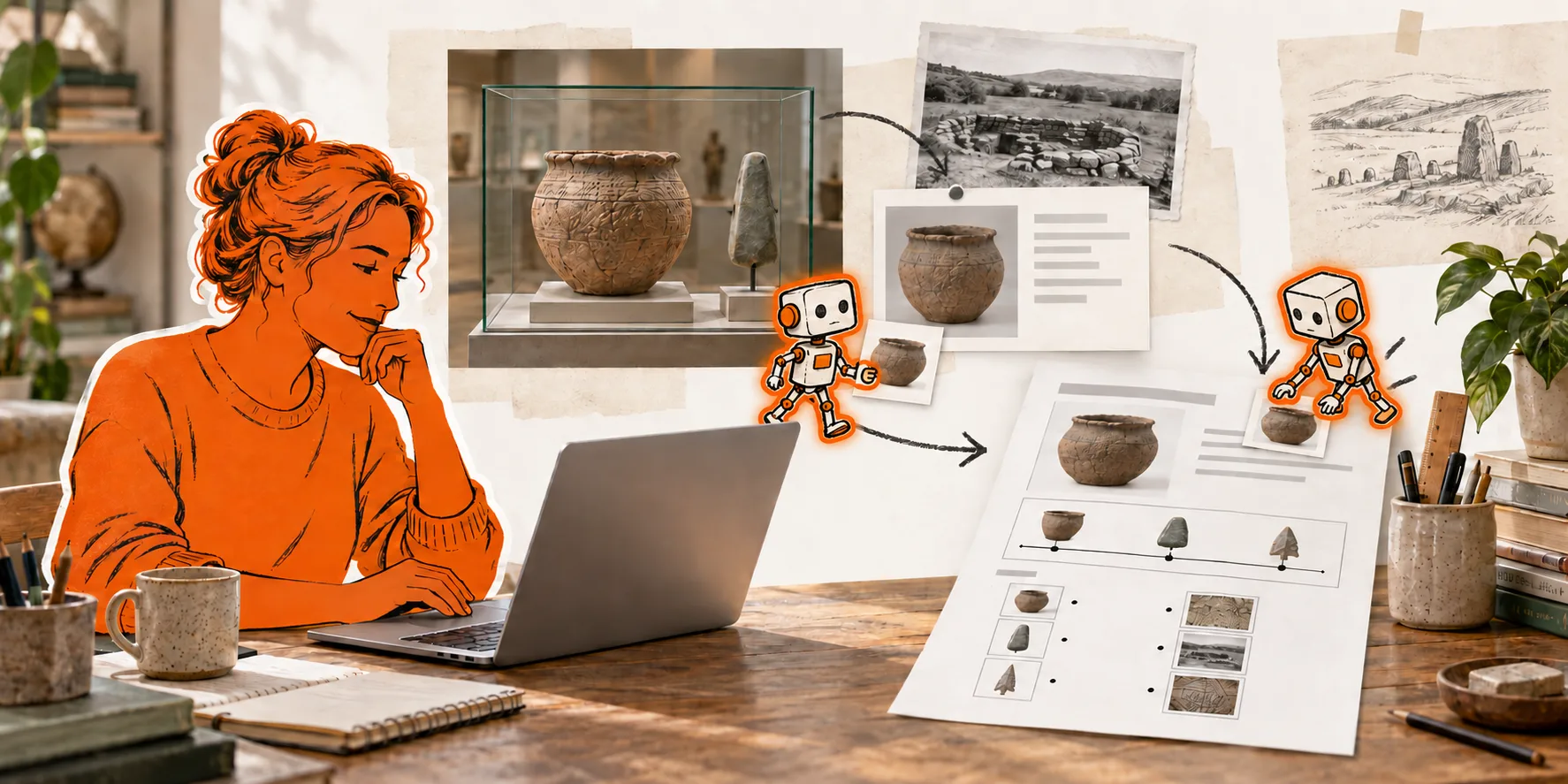
Imagine a teacher asking: “Prepare a 45-minute lesson about life in Neolithic Scotland for my class of nine-year-olds. Use these curriculum outcomes, include objects from a museum collection, and give me an activity we can do without visiting.”
An agent could search museum collections, retrieve object descriptions, check which images are available for classroom reuse and consult the curriculum material the teacher specifies. It could then assemble a lesson plan, a worksheet and source links for the teacher to review. Where evidence or permissions are unclear, it should say so. The teacher would still judge the accuracy, suitability and fit with the intended learning outcomes.
The museum might already have an education pack. The teacher may need a different age level, language, lesson length or connection to another subject. Clear, reusable collection information could support all those variations without the museum having to anticipate and author every pack.
There is a slightly awkward possibility here: the museum could spend months preparing the perfect downloadable pack, while the teacher's agent struggles to retrieve the object information needed to create the lesson the class actually needs.
No purchase is involved. The museum's collection is helping someone learn. Useful preparation would include searchable descriptions, stable links to individual objects, provenance, clear image credits and reuse terms. The museum can publish those foundations while learning which educational uses people find valuable.
Asking AI to rewrite an uploaded pack would be a simpler use of AI. The agent example goes further because it undertakes a sequence of searches, checks and assembly across sources on the teacher's behalf. It also shows why a useful agent experience need not involve checkout, a new booking system or a particular protocol.
Prepare information beyond the first project
Make information reusable across the organisation. Product details, service descriptions, specifications, locations, eligibility rules and policies should be clear, current and organised so they can support uses beyond the page or document they were written for. Ask whether you can retrieve, combine and update that information without rebuilding everything around it.
That preparation can cover information you do not yet intend to expose to an agent. Keep control over who may access it: public information, personal account details and confidential internal information have different audiences. Preparing information for authorised reuse does not require publishing it all.
Choose a first task small enough to test properly, while asking your suppliers how the same foundations could support a different task next year. Keep listening to the people who use your services. Some of the most valuable opportunities may emerge from what they try to do, rather than what you originally planned to offer.
What the decisions look like
There is no sensible default in which agents can do everything. The boundary depends on the organisation, the value of the action and the consequences of getting it wrong.
| Organisation or service | Good candidates for agent access | Likely human or explicit-confirmation boundary |
|---|---|---|
| Visitor attraction | Opening times, accessibility information, prices, live ticket availability and standard admission bookings. | Unusual group arrangements, complex access needs, discretionary refunds or changes with material cost. |
| Museum learning service | Find collection objects, retrieve reusable images and source material, and assemble a lesson around a teacher’s brief. | The teacher reviews accuracy and curriculum fit. Unclear evidence or reuse permissions need checking before classroom use. |
| Hotel | Find rooms, compare rates and policies, make a standard booking, add a cot or record a late arrival. | Negotiating a group rate, interpreting an exceptional request or cancelling a non-refundable stay without clear confirmation. |
| Retailer | Find products from a need, compare specifications, check stock and delivery, build a basket and buy within an agreed limit. | Substituting a materially different product, accepting unexpected terms or making a high-value purchase without approval. |
| Professional services | Understand expertise, assess likely fit, gather initial information and book a conversation. | Giving binding advice, agreeing scope, setting a final price or creating commitments on the client's behalf. |
| Healthcare or care | Find services, eligibility and locations; complete low-risk administration; arrange appropriate appointments. | Clinical judgement, emergency triage, consent-sensitive decisions or anything where an incorrect inference could cause harm. |
The principle is simple: make routine, well-bounded tasks easier to delegate. Keep meaningful judgement and consequential exceptions visible.
This is becoming a technology-buying criterion
A platform bought in 2026 may still be running in 2031. You may not need to expose agent capabilities this year, but it is increasingly difficult to justify choosing a system that makes doing so needlessly hard later.
If you are choosing an ecommerce platform
Ask how it will make product data available to AI shopping services, keep price and stock current, preserve your terms and complete transactions safely.
Shopify is a useful example because it has made a clear platform choice. Shopify Catalog structures and distributes product information to AI channels, while its agentic commerce work connects discovery with established checkout, payment, fraud and fulfilment systems. Shopify says its Universal Commerce Protocol, co-developed with Google, supports carts, checkout, payment and post-purchase interactions across participating agent platforms.4
That is not, on its own, a reason for every retailer to choose Shopify. It is a reason to ask every shortlisted platform for an equally clear answer.
If you are choosing a CMS
Do not reduce the requirement to “Can we add a meta tag?” Ask whether you can:
- publish accurate structured data for your actual content and services;
- control titles, descriptions, canonical URLs and machine-readable outputs without template workarounds;
- make important content available in clear HTML rather than hiding it behind scripts or documents;
- represent relationships such as places, events, offers, people, policies and availability;
- add or adapt emerging agent-facing mechanisms without replacing the CMS;
- keep information current in one authoritative place;
- reuse and export that information for new services and channels, including ones outside today's website brief.
If you are choosing a booking or operational system
Ask for a proper, documented API. Can another approved service reliably read availability and price, create a provisional reservation, confirm a booking, change it and receive a meaningful error when something cannot be done?
A system that only works by making a person click through its own interface may still be usable today. It is a weak foundation for delegated tasks.
If you are signing a long support or technology contract
Include agent access in the roadmap and exit discussion. Ask who owns the data, who can build integrations, what costs apply, whether actions can be permissioned and audited, and what would be required to support emerging standards.
Do not buy on promises of “AI-ready”.
Ask the supplier to demonstrate how an external, authorised service can discover accurate data and complete one real task for someone using your service. “It is on our roadmap” is useful information, but it is not a capability.
Where WebMCP fits and where it does not
WebMCP is one proposed way for a website to describe useful actions directly to an AI agent in the browser.
Without it, an agent might inspect a page, infer that a control opens a date picker, work out how the calendar behaves and click through several steps. With WebMCP, the site can expose a structured action with defined inputs and outputs. The agent is given something closer to “search availability using this date and party size” than “look at the screen and have a go”. Google describes this as a progressive enhancement: the human website remains, while the agent gains a more reliable route through selected tasks.2
It is promising, but it is not settled infrastructure. As of September 2026, WebMCP is a W3C Community Group draft, not a W3C Standard, and Chrome describes it as under active discussion and subject to change.3
It also solves only part of the problem. It can help an agent understand and use capabilities in a live browser session. It does not replace the need for correct implementation of your rules, secure identity, reliable data, payment controls, operational rules or human confirmation.
WebMCP should therefore appear on a technical watchlist. It should not be mistaken for the organisational decision.
A sensible roadmap for the next 12 months
- Name the journeys. Identify the five or six things people most often need to discover or do with you. Include things they currently have to phone or email about, and requests your systems cannot yet accommodate.
- Set the boundary. Decide what an agent may discover, recommend, prepare, complete or never do without a person.
- Test the reality. Ask current agents to attempt two or three important journeys. Observe where information, interface or process breaks down.
- Prepare reusable foundations. Improve content, accessibility, structured data, form labels, system APIs and operational rules. Make information usable beyond the first project, with access controlled according to its purpose and audience.
- Question suppliers. Add agent accessibility to CMS, ecommerce, booking, CRM and support-system reviews and procurements.
- Prototype one bounded task. Choose something useful and low risk, define success and test it with the people who would use it before exposing more.
- Keep learning. Assign someone to follow how people use your services and supplier developments. Review the roadmap quarterly, and sooner when a new capability or request changes what is possible.
You may reasonably decide to defer a live implementation. Give that decision an owner, a review date and a reason to reconsider: a supplier releasing a useful capability, people asking to use agents, or a new service becoming feasible. Continue preparing your information and reviewing upcoming purchases while you wait.
Seven questions to take into the next meeting
- Which tasks could agents make easier for the people we serve, including things we cannot currently offer online?
- Which information would the agent need, and where is the authoritative version held?
- What may the agent recommend, prepare or complete?
- Where must the person using the agent see and confirm the action?
- Which exceptions require a person, and how will the handover work?
- Can our current systems expose the necessary data and actions safely?
- Will today's technology decisions leave us able to support uses we have not yet anticipated?
Keep your organisation able to participate.
Choose useful journeys to start with. Prepare your information for reuse, retain human judgement where it is needed and buy systems that can adapt. Leave room for people to show you uses you have not thought of yet. What they need from your organisation will not stand still.
Sources and status
This article separates current capability from direction of travel. Standards and platform availability will change, so the dated sources below should be checked when the article is updated.
- GoogleChrome Lighthouse 13.3 release notes, May 2026; and current Lighthouse releases. The release notes record the Agentic Browsing category being added to the default configuration and subsequent PageSpeed Insights work.
- Chrome for Developers: WebMCP, published May 2026 and updated August 2026. Google describes structured tools, progressive enhancement, current limitations and the Chrome origin trial.
- WebMCP Draft Community Group Report, 10 September 2026. The document states that it is not a W3C Standard and is not on the W3C Standards Track.
- Shopify: Agentic Commerce on Shopify, June 2026. This is Shopify's description of Catalog, Agentic Storefronts, checkout and the Universal Commerce Protocol; availability and eligibility vary by market and channel.