Public Services
Behavioural evidence for discovery, service improvement and inclusive public services, from first contact to getting help.
Explore public servicesDesigning for Decisions
Help people understand, decide and use your services with confidence.
FabUX combines user research, usability testing and behavioural evidence to improve public services, commercial journeys and visitor experiences across Scotland and the UK.
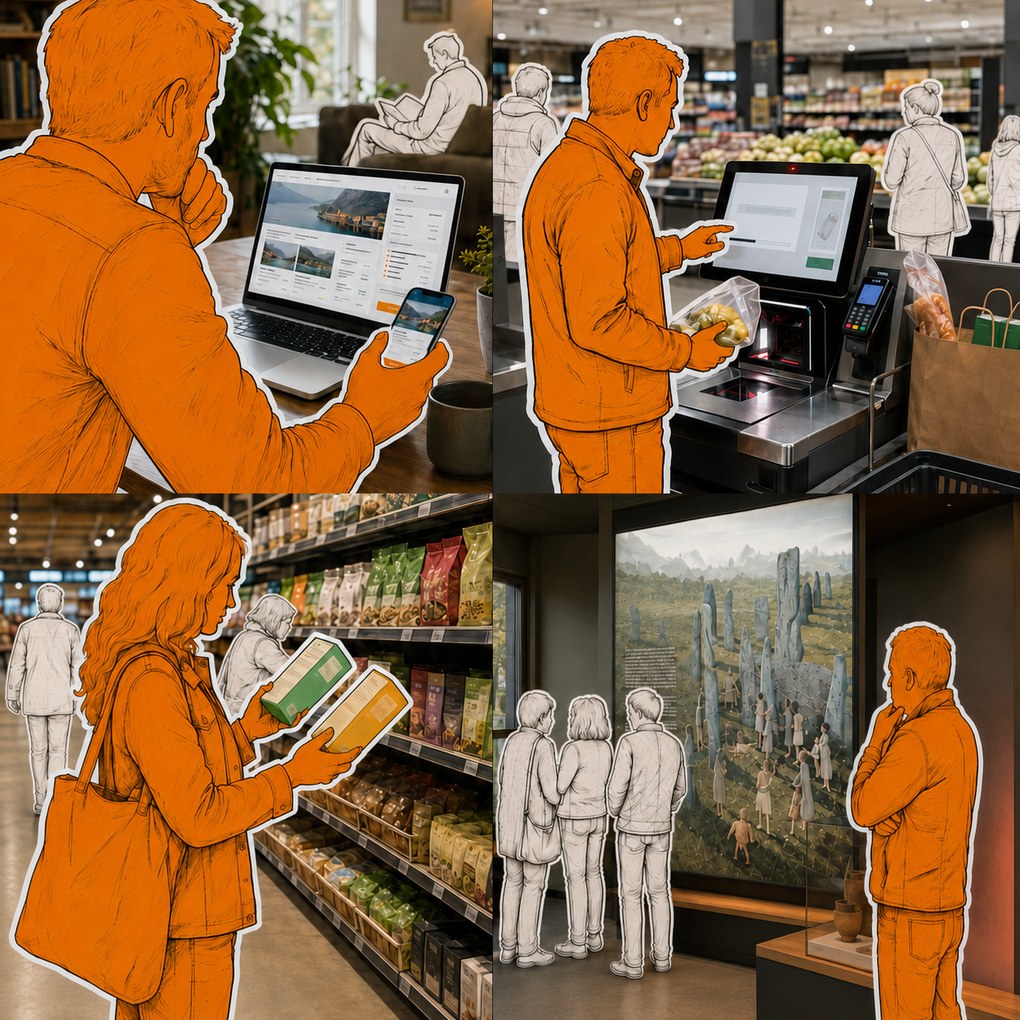
Through our Designing for Decisions (DEX) approach, we combine behavioural observation, decision architecture and brand-led experience strategy to help organisations become easier to understand, trust and choose - for people and increasingly AI systems alike.
Remote research for reach. Face to face where context matters. Often both.
Public services & communities
From discovery to reviewing a live service, we help teams understand what people need and where they struggle. Our UK-wide work includes particular strength in the Highlands and Islands, specialist recruitment and fluent Gaelic-speaking moderators.
Behavioural evidence for discovery, service improvement and inclusive public services, from first contact to getting help.
Explore public servicesRural, island and Gaelic-language research, including specialist work packages within wider UK programmes.
Explore highlands & islands researchAreas of expertise
FabUX connects behavioural evidence with practical improvement across digital and physical experiences. Choose the area closest to the problem you are trying to understand.


How we research
01
Agree what your team needs to decide, who needs to take part and where the experience happens. Plan recruitment, access needs and research privacy from the start.
02
Watch people attempt realistic tasks or move through a place, using remote sessions, face-to-face research or a blend. Give them room to act without a running commentary.
03
Use retrospective questions to explore what participants expected and understood. Consider their explanations alongside observation and, where useful, eye-tracking evidence.
04
Translate findings into clear priorities for content, journeys or environments. Test changes against the original question and be explicit about what the evidence does and does not show.
New from FabUX

Thinking
A hotel booking example for a web made usable by AI agents.
Read the article
Foundation by FabUX
Read it online, download the editable document and adapt it. No registration or email gate.
Use the free AI policy
FabUX Field Guide
Practical guidance for heritage, museums and visitor attractions.
Read the Field GuideAI has changed how people discover you. Human behaviour still determines whether they trust you.
Most organisations compete for attention. The best compete for understanding.
People rarely study experiences carefully. They scan, interpret, judge and decide remarkably quickly.
Brand shapes interpretation before interaction begins.
Ambiguity creates assumptions. AI systems amplify them.
Understanding decisions
The strongest brands do more than attract attention.
They create confidence. They reduce uncertainty. They shape expectations. They help people feel they are making the right decision.
Because brand is not simply how something looks.
Brand is how people interpret, trust and remember an experience.
People remember how you made them feel.
Research delivery
FabUX conducts research across Scotland and the UK. We’re experienced in arranging face-to-face sessions wherever the work requires them, including hiring research facilities and suitable venues in cities, towns and remote communities.
We combine remote sessions with in-person research around the people, tasks and environments we need to understand. Our Isle of Lewis base also brings local knowledge and access to rural, island and Gaelic-speaking communities.
Explore our research methodsEye tracking and retrospective recall
AI principles
When AI becomes part of a service, we research how people use its answers, recognise its limits and find human help. This can be a focused study or part of a wider public-service or product research programme.
Explore UX research for AI services
AI is a powerful operational lever.
It helps manage complexity, improve consistency and maintain detail without fatigue. We use AI throughout our workflows and deliver AI-friendly documentation designed for modern organisations and future systems.
But AI is not a shortcut to understanding.
We do not use synthetic data, simulated participants or AI-generated behavioural research presented as real human understanding.
AI systems naturally bridge gaps with assumptions.
Our role is to help organisations reduce those gaps through clearer positioning, stronger decision-making and a deeper understanding of how people really interpret, trust and choose.
Whether you are improving a public service, booking journey, product experience, visitor environment or organisational clarity, tell us where the uncertainty is. A few lines are enough to begin.